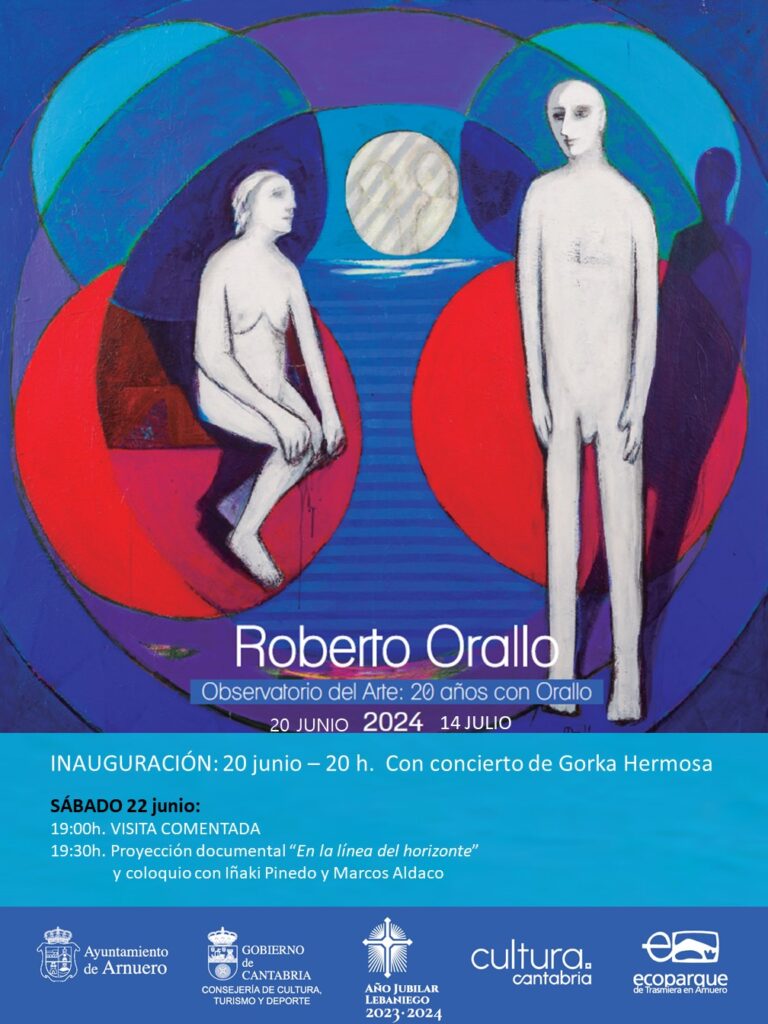
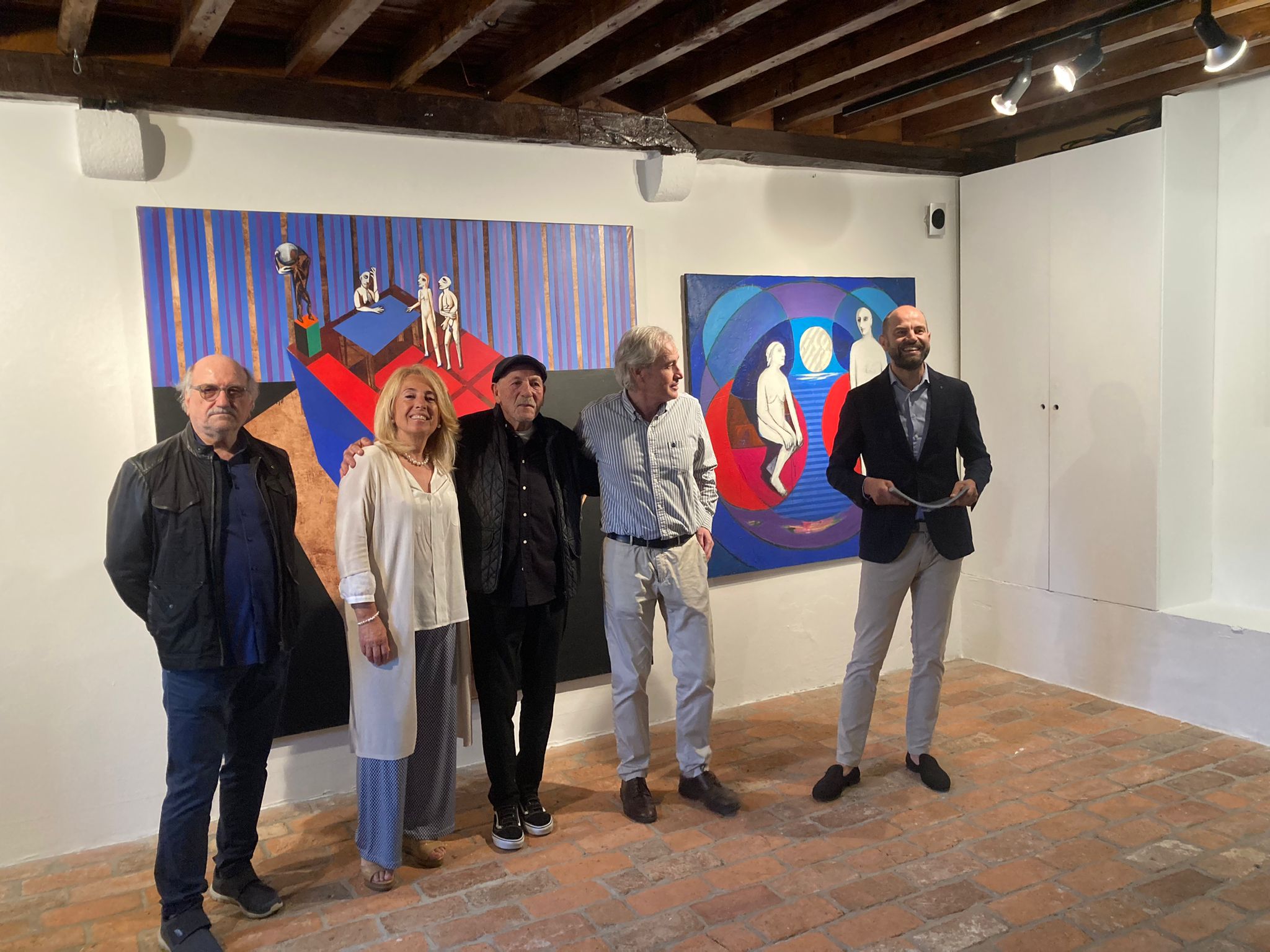
Last Thursday, 20 June, the exhibition “Observatorio del Arte, 20 años con Orallo”, was inaugurated at the Art Observatory, bringing the event to a close with a short concert by accordionist Gorka Hermosa.
Roberto Orallo has returned to the Art Observatory in Arnuero, now transformed into an Exhibition Hall thanks to his intervention twenty years ago—a milestone being commemorated in 2024. Nothing could be better than this display being introduced by the painting titled From the rooftop, one of the pieces from that series that was first made known in 2004.
Roberto has returned to this corner of Cantabria accompanied by his canvases, which reflect the creative richness and the work of these years, exhibited in different exhibition spaces, and which, once they reach here, stand as a testament to an artistic identity and a style that is perfectly recognisable—subject to evolution over time.
The years that have passed since then have also served to recognise Roberto Orallo’s artistic and social contribution, beginning with his teaching work. In 2008, collaboration between the Department of Culture and the Town Council of Reocín led to the creation of the School of Art of Cantabria, with Roberto overseeing its direction and launch—a collaboration that was acknowledged by giving the school his name. Just a couple of years ago, in 2022, Iñaqui Pinedo and Marcos Aldaco led the audiovisual project titled On the line of the horizon, in DVD format, in which Orallo explains the creative process as part of his personal biography. But the cherry on this cake was added by the Government of Cantabria when it made 2023 the Roberto Orallo Cultural Year, enabling the artist’s work to travel across different venues in Cantabria, ending in Spain’s capital.
The canvases that make up this exhibition—an overview of Roberto Orallo’s creative moment—are almost all made using mixed media techniques, evoking one of the notes that best defines his work: the creation of thematic series, like narratives. These works compile faces, bodies, and colours, subjected to geometric discipline. The gazes are serious, expectant, curious, friendly—faces pressed close, always reflective.
A constant in Orallo’s aesthetics is his work on space, which he endows with new dimensions through lines that cross the canvas, as if they were sentences, sometimes with great violence, while other times, generally curves, frame and limit the complexity of a sphere inhabited by objects and people who suggest some secret relationship among them.
Roberto Orallo is back—now in Arnuero, perhaps because he never really left.
Carlos Nieto Blanco