
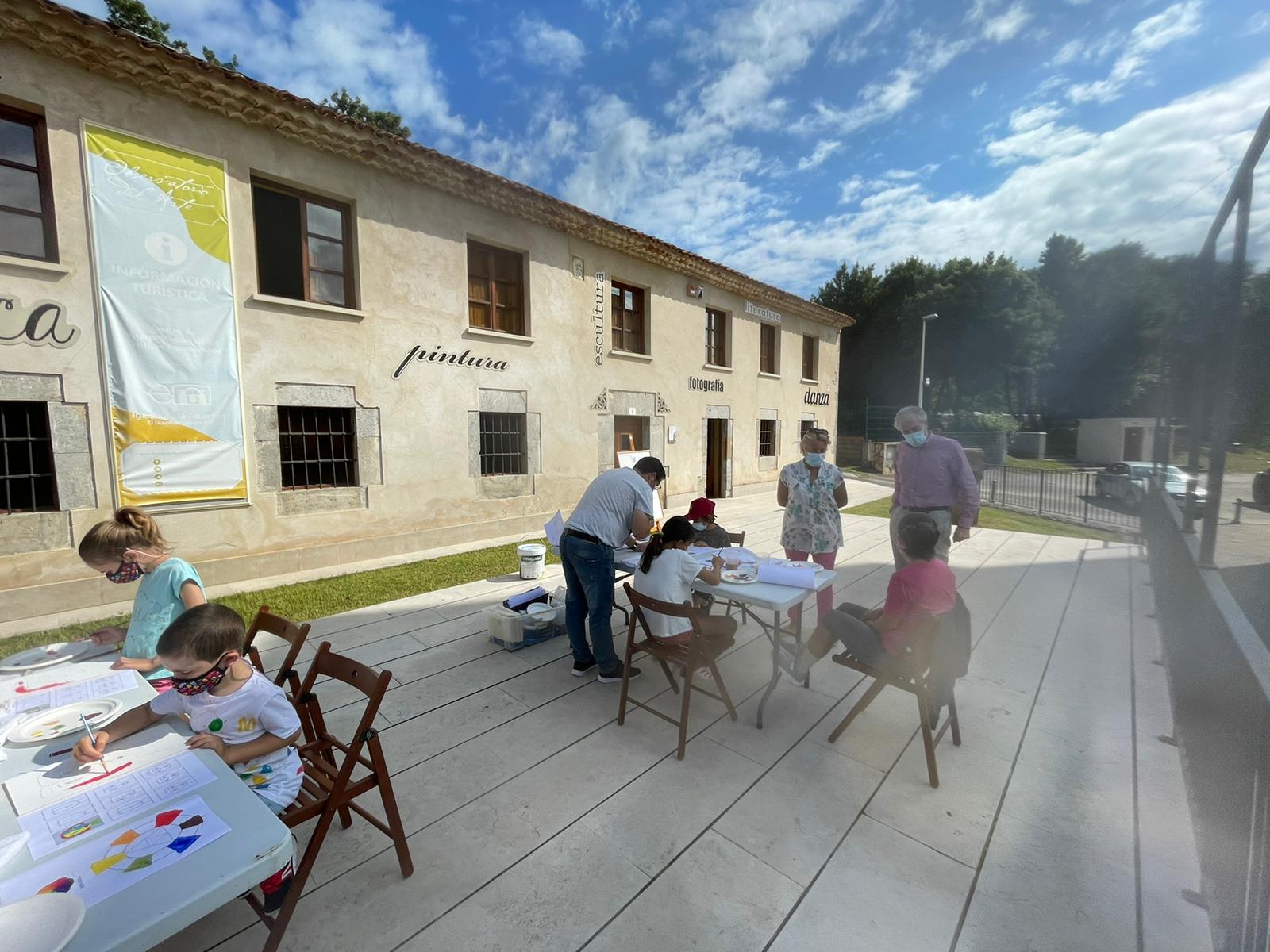
 The exhibition “Picasso, venti pochoirs originali” was inaugurated on Saturday 24 July with a children’s painting workshop, in which an approach was taken to a technique that Picasso used to make the leap towards Cubism. The children and their families visited the exhibition in a guided tour, before moving on to a workshop in which each of them could experiment with the technique of the pochoir and create a Cubist drawing. The workshop will be held on a second occasion on next Saturday 31 July at 10:30, for which it is essential to register in advance by calling the tf. 676486111 or by email at info@ecoparque.info and to reserve one of the 10 available places.
The exhibition, also subject to prior appointment, may be viewed until 18 August inclusive, with the exception of Mondays and Tuesdays, when the Art Observatory will remain closed.

SERIE VENTI POCHOIRS ORIGINALI
Venti pochoirs originali is a 1955 edition comprising twenty works produced during Pablo Picasso’s Cubist period.
This period is essential in the artistic career of the Málaga master, and for that reason, in the 1950s he decided to create this series of 100 copies with the help of the Milan-based publisher Silvana, with writings by Franco Russoli.
The pochoir technique is perfect for these Cubist works by Picasso because it makes it possible to overlay planes and change perspectives—something essential for Cubism. It also allows the use of different colours that appear in the works with great luminosity.
The theme of this series is very varied: we find everything from the iconic Cubist still lifes to female portraits, without forgetting the figure of the harlequin, and we can highlight several studies for the work Les Demoiselles d’Avignon.
In total, the original drawings used for this pochoir series cover a period that begins in 1904 with Les Misérables and ends in 1951 with the work Maternity with orange. In this way, these twenty works allow us to get closer to major creations spanning five decades, in Russoli’s words: Picasso “reinvents on each occasion all the formal languages of tradition, and even the most inert and generic representative signs of someone who is interested solely in significance and not in formal achievement, and in the symbolic fetishes”.
ABOUT THE POCHOIR TECHNIQUE
In our language, pochoir translates as stencilling or stencil (in English it is called stencil, in French it is known as the technique of “pochoir” or template), and it is a direct printing technique by stamping through a template on which an artistic, decorative or technical design is previously drawn, traced, cut out and masked with a scalpel, in order to spray, dapple and apply paint through reserved areas or open spaces previously removed by the action of the cuts, thus obtaining an image on a substrate by transfer. The template is a printing technique that allows multiple characters or patterns to be reproduced on various media. The template is also the “sheet of card or cut of metal, in colour with a paintbrush; the drawing has the outline of the cut”, according to the Larousse dictionary definition from 1874. Stencil has been used for centuries for a wide range of purposes. Very often, this technique is used to form letters.
This type of printing has been used since ancient times as a stamping instrument using templates. In China and Japan it was originally made using intertwined human hairs, attached to paper silhouettes, in order to construct a portable model or guide with a decorative design or illustration and apply it directly in series to fabric, on walls and ceilings, and commercially, as an instrument for marking packaging with seals and calligraphy using, later on, silk threads, which were joined together as fabric between the two layers. In the Middle Ages it was used to colour playing cards and decks, whose images had previously been engraved using the woodcut technique.
In the first half of the 20th century this printing method was widely used in Paris by artists such as Braque, Van Dongen, Miro, Matisse, Dufy, Léger, Modigliani, Rouault and, of course, Picasso. They had rediscovered this Japanese-origin technique, which allowed them to add colours to contemporary illustrations with an unmatched quality.
These manual reproductions were carried out in specialised workshops in Paris, and were characterised by wonderful colour vibrancy. Different types of templates, brushes and paints (gouache, silver or gold paint) were used to achieve this effect. For a simple pochoir, figures or texts are cut into a thin metal or plastic sheet. These templates are then placed on paper or another surface.
The basic equipment for stencilling by an stencil artist is minimal, light, and could be reduced to drawing instruments, cutting scalpels, templates taken from industrial products derived from cellulose, plastic or metal; oil-based paint, aerosol-packaged lacquers, adhesive tapes, gloves and anti-gas masks; using roller, brush or sponge printing techniques to print their messages around the city with an air of urgency.
Nowadays, artists such as Banksy or Vhils often use this reproduction technique when creating their art in the streets.