
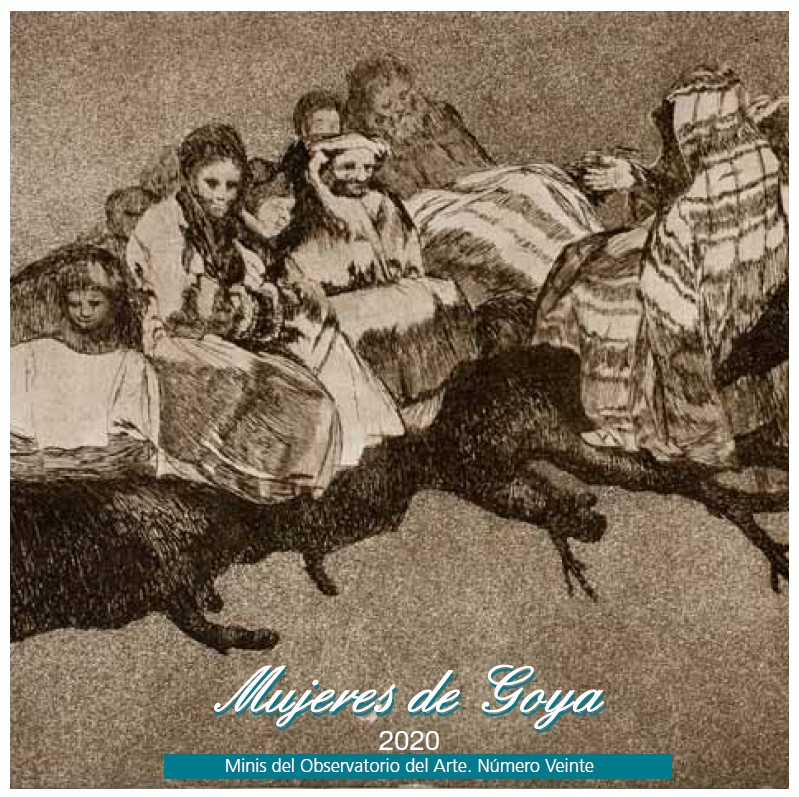
“MUJERES DE GOYA” will be the next exhibition hosted by the Art Observatory, a selection of engravings by the genius from Aragon in which he offers us a critical view of women in his time. No one should miss this exhibition; however, COVID19 measures mean we can only offer visits by APPOINTMENT, in reduced-capacity groups. They will be from Wednesday to Sunday, and you can reserve your place by calling the Tf. 676486111 or by email info@ecoparque.info
The pictorial and portraiture typology of women forms part of the artistic output of Francisco de Goya. Few artists have been able to move away from the idea of woman as a static muse, in order to portray her in different facets. We will see different female models “immortalised” in a historical moment when women lacked the recognised position they have in society today. They are brave women like Agustina de Aragón, fighting and supportive women, nonconformists; he even immortalises a female bullfighter as “la Pajuelera”. Moreover, it shows the bitter face of reality through prostitution or misogyny. Of course, we cannot forget “the majas”: those freer and more transgressive women from the town whose clothing was copied by the ladies of the aristocracy who so wished to be portrayed by Goya. Today, with centuries of distance, we can see that this presence is not limited only to commissioned works; rather, in his graphic output, his freer creations give women an undeniable leading role. The artist produced four major series of engravings Los Caprichos (1799), La Tauromaquía (1814-1816), Los Desastres de la guerra (1810-1820) and Los Disparates o Proverbios (1815-1824). More than two hundred works that not only have great artistic value, but, with the perspective of time, we can say they represent an unmatched chronicle of the artist’s era.
Through this exhibition, we delve into the analysis that Francisco de Goya carried out of the female world throughout his long career. An analysis made with the brilliance and modernity characteristic of the master from Aragon, which makes him an essential figure in the History of Art—capable of giving a voice to those who were silenced, as were the women of his time.
